Three Stories from the Guggenheim
Content Warning: Artsy-fartsy-ness, potentially bad takes on modern art
The Guggenheim Bilbao is a spectacle. Designed by Frank Gehry, it’s something to behold, all curves and weirdness in exactly the ways that modern art museums should be. Visiting the Guggenheim played quite the foil to running the half marathon last week - somehow equally tiring and stimulating, but for totally different reasons. I had high expectations going in to one of the world’s most renowned modern art museums, and I’ll preface this by saying that it did not disappoint in the slightest.
I had three experiences at the Guggenheim that I want to share. This post will be quite different from the others in that there’s nothing really special about the travel/sabbatical itself, but rather the exhibits that moved me the most. So, if you’re not the type to read totally unprofessional and subjective takes on art, you should skip this one.
The Matter of Time (Richard Serra)
The Guggenheim is huge. You would be forgiven in thinking that you would go in and see a ton of art. But you won’t. Instead, you’ll see massive installations of singular works of art, and Serra’s The Matter of Time is the perfect example of this. Seen from the balcony on the second floor, the sculpture extends the length of more than an American football field. It is essentially a maze, with high walls constructed in swirling, looping patterns across the floor, all the same color and vibe. There are no instructions for how to interact with it - it’s just there, imposingly daring you to walk inside, around, or avoid entirely.
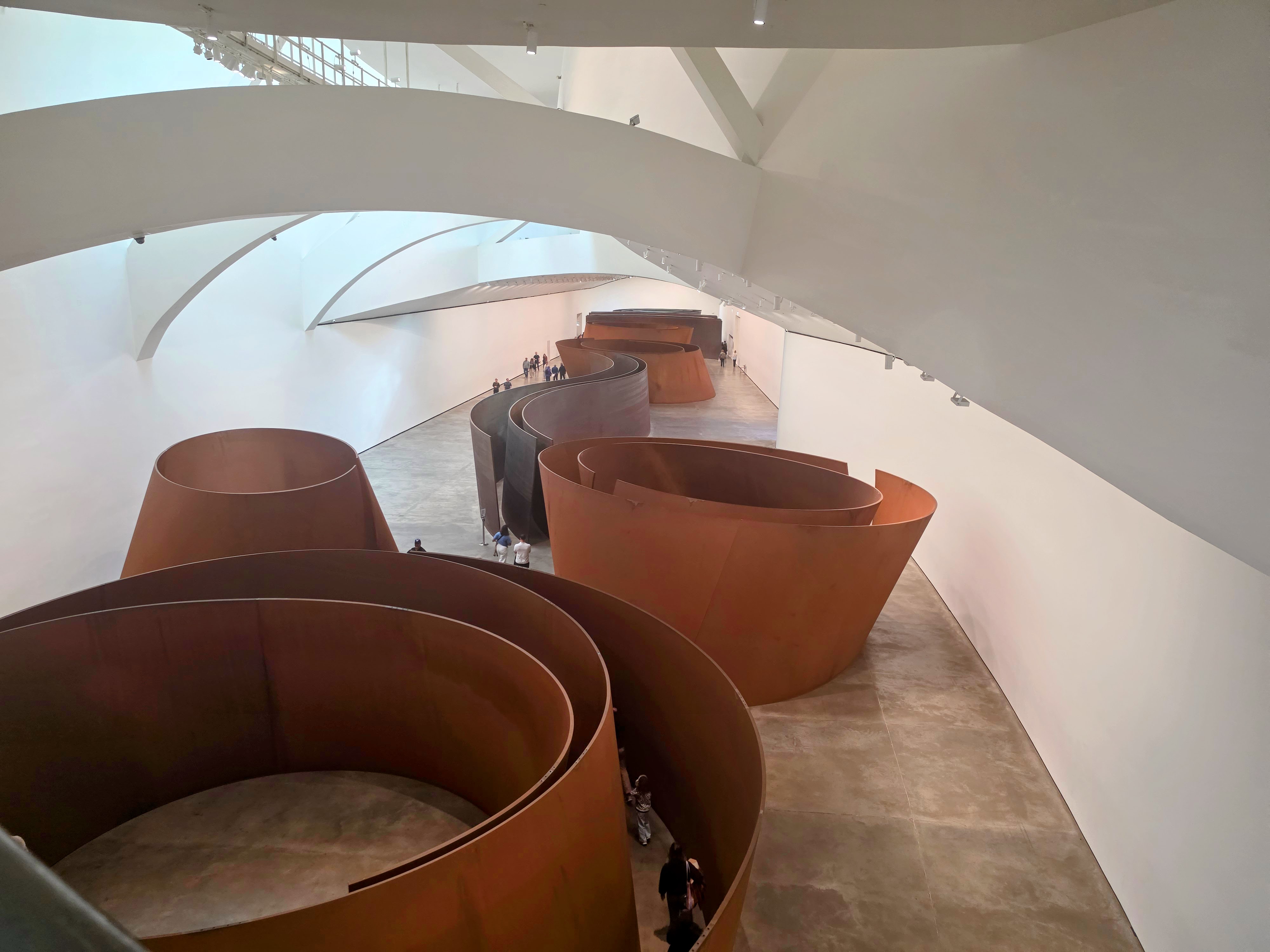
I didn’t get it at first (common for modern art, especially for me). But I stuck with it, waking in and out of the structures for about 15 minutes before coming to the realization that the piece wasn’t at all meant to be the walls, but rather the very thing I was doing. The people are the art. It is designed in such a way that it is easy to walk inside or outside, to take your own route, to turn around whenever you want. The thousands, millions of patrons who walk its paths are themselves the work of art. There are an infinite number of permutations of paths you might take - no two museum visitors have ever independently walked the same path on that floor before. Taken together, the beautiful, curving walls are only there to guide the real medium - footsteps and time.
I started to imagine the piece as a time lapse. All those millions of footsteps taken together forming a unifying, yet totally unique, experience. There are the children who run - giggling - through the tight passageways again and again. There are the elderly couples on dates, meandering at their own pace, arm in arm. There are the new parents struggling to navigate a stroller through some of the tighter spaces, wondering if the exhibit is really appropriate for them (it is). Your voice echoes off the walls as you wander, and with perhaps a dozen languages all spoken at once, the sounds combine into something unintelligible but far from ugly.
I think Serra absolutely nailed it. You get this sense of wonder, curiosity, and discovery. You walk these tight, swirling paths that lead to nothing - just spots to turn around and retrace your steps, and you’re forced to confront the fact that since the path doesn’t lead you to any art, that must mean that you are the art, as the path would be nothing without you walking it. It’s a joyful realization, not at all snobby or high brow. It’s the artist looking at all the people who will experience his work and saying to them, “You are beautiful - what you add to this experience is perfect, and you are not lost. You’re exactly where you should be.”
It’s perhaps the only maze that’s impossible to become lost in.
66-76-26 (Steve McQueen)
You walk into a dark room. The room is huge - gymnasium-sized. It is totally sound-insulated. From one wall, a massive speaker plays Nina Simone’s 1966 rendition of Wild is the Wind. From the opposite wall, an identical speaker plays David Bowie’s 1976 rendition of, you guessed it, Wild is the Wind. Both renditions are stripped of all instrumentation, leaving only the vocals. It’s loud. There is nothing else in the room, not even light. They recorded the song 10 years apart and in their own distinct styles, without ever knowing that McQueen would come along in 2026 and unite them. At times, they don’t mesh well together. At others, they sing in unison. They even seem, occasionally, to be singing in call-and-response, across time and space.
You feel it in your chest. The song is painful, and you are blasted by that pain from both sides, in different registers, from people going through the most painful times in their lives. There’s nothing in the room to distract you from confronting that pain. You can walk towards one voice, or towards the other, or towards the center, or you can leave. There’s no sign prohibiting photography, as there is no image to capture. Whereas Serra’s sculpture is pure joy and togetherness, this piece is empty, yet full to bursting. My hat is off to the curator for juxtaposing these two massive installations so close together (they are adjacent on the first floor). But also, how dare the curator make me feel so many things in such a short span.
Wild is the Wind (originally written by Dimitri Tiomkine and Ned Washington, 1957)
Ever is Over All (Pipilotti Rist)
Rist’s piece is a film projected on a huge wall. In the film, a beautiful woman in bright red lipstick, bright red high heels, and a sky-blue dress holds a large tropical flower while walking - practically dancing - down a city street. The street is gritty - there’s graffiti, no trees or plants other than her flower, and there are hardly any people. She walks by a car and smashes its window with her flower. She smiles. She does this a few more times, and a police officer turns the corner towards her in the background. The tension grows. She keeps smashing windows with her flower, and the cop gets closer. The cop eventually gets close enough so that the viewer can make her out - she’s a woman wearing bright red lipstick. She smiles at the woman in the blue dress, waves, and moves along. The woman smashes another window, and the film repeats.
All the while, hypnotic imagery of tropical flowers is projected on the adjacent wall, and an equally entrancing soundtrack plays, punctuated by the smashing of glass windows.
It’s a heady piece of feminist power, rage, and joy, and while I really enjoyed it, that’s not why I bring it up here. I watched the video through once, and I turned to leave. Just then, a school group entered the exhibition. The kids were no older than six, corralled by a single chaperone (my heart went out to her immediately). I can’t imagine who made the decision to take kids this young to a museum this challenging. The museum has works by Rothko (think splotchy rectangles and little else), Basquiat (think “my kid could do that” drawings), and the famous 150 Marilyn Monroe faces by our favorite Campbell’s Soup guy, Andy Warhol. It has a detailed description of how two artists slathered their naked bodies in blue paint and rolled around on the canvas (complete with pictures of the process). It’s not easy art for adults, let alone kids learning their letters and numbers.
So, I stayed rooted in place, dying to see how the kids would react to this film. I’ve never seen kids that rapt before. They were utterly transfixed. They were shocked that this lady would so brazenly smash windows, and they were shocked that the cop didn’t stop her. Their faces turned from shock to guilt to guilty pleasure, and with their faces they asked all the questions they should be asking. Shame on me for assuming that kids can’t do high art, and shame on me for being spoiled with the experience of getting two works of art for the price of one - the film itself and the priceless reaction.
The other parts of the museum were more in line with what I expected. There was a Yayoi Kusama exhibit that I skipped (I’ve seen a few of her other exhibits at other museums and they aren’t my favorite, plus the line was impossibly long). Igshaan Adams’ tapestries were stupendously beautiful and fascinating to behold (and I really appreciated the little explainer that the museum provided). There was a moving tribute piece to the families displaced and captured by the conflicts in Syria - a Times Square-style digital ticker suspended vertically from the ceiling, scrolling through the text of interviews with those tortured by the Syrian regime or those who had fled. I love a Rothko and a Rosenquist, and it was exciting to see all those Marilyns in neat rows. There were plenty of artists too brainy for me (Basquiat is a memorable one). But overall, the museum exceeded the hype in my eyes.
And, just look at this little guy!
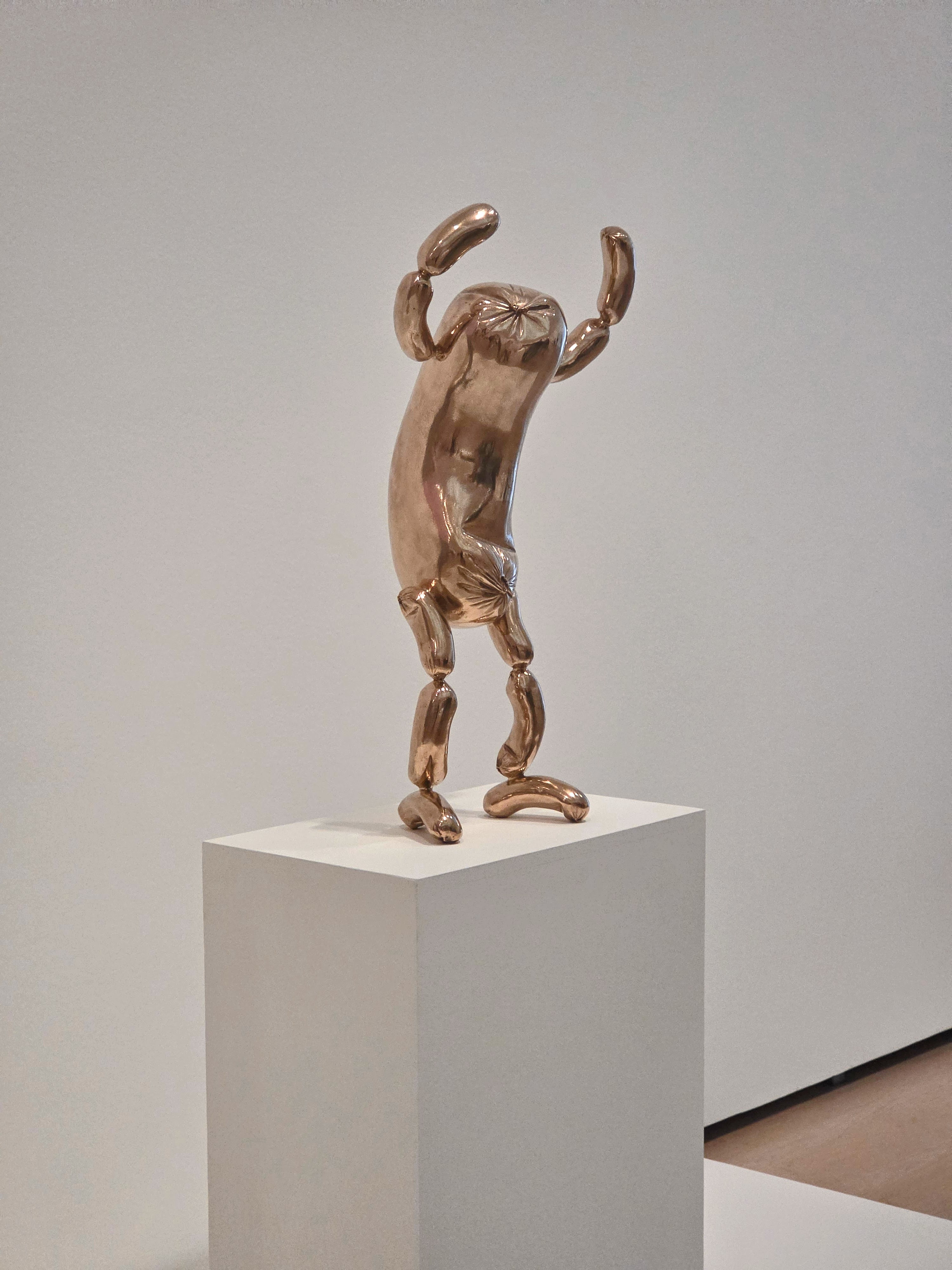 (How I feel when I get to be pretentious about modern art)
Ok - I promise not to do this again. Unless, of course, I go to another really great museum, but what are the odds of that?